

How to Run a 5-Day AI Design Sprint
Workbook and Video Walkthrough

The AI Design Sprint
Workbook


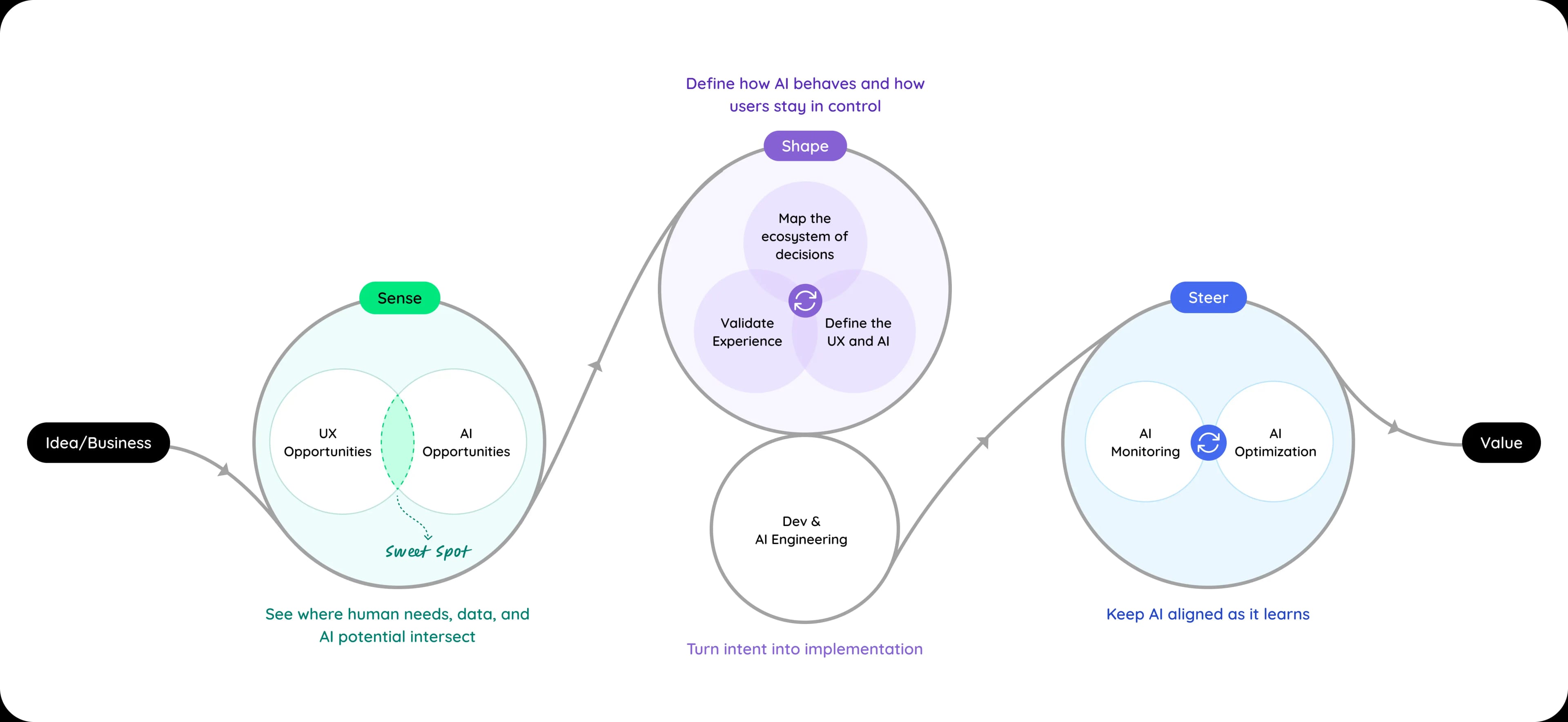
Introducing A Closed-loop Approach To Creating AI Products That Keep Improving After Launch
In this training, our team walks you day by day through the AI Design Sprint
Workbook. The exact prompts, exercises, interaction pattern cards
and decision frameworks we use to take an AI opportunity from "we should add AI"
to a build-ready product direction in five focused sessions.
Here’s what each day covers:
5-Day
AI Design Sprint

Day 1
Start with the user, not the technology.
- Map pain points and current workarounds
- Identify where AI can bring relief (and where it shouldn't touch)
- Assess what data is actually available
- Align on the AI's role: copilot, agent, conversational or ambient
You'll walk out of Day 1 with a grounded AI opportunity statement that sets the direction for the rest of the sprint.
Day 2
Take each pain point and treat it as its own AI design problem.
- Run it through structured decision prompts covering user clarity, urgency, disruption risk and risk radius
- Match each one to the right interaction pattern
- Define whether the AI acts as an assistant, guide, collaborator or executor
This is where you stop your team from over-automating things that should stay under human control.
Day 3
Turn those behaviour decisions into concrete interaction flows.
- Map AI touchpoints across the full user journey: where AI initiates, where it responds, where control returns to the user
- Storyboard the flows
- Build wireframes you can validate with stakeholders or real users before engineering writes a line of code
Day 4
Define what "good enough" actually means for your context.
- Set accuracy thresholds, fairness metrics and usability benchmarks
- Define trust indicators, safety guardrails and escalation behaviours
- Establish feedback loops and operational metrics
Not decimal-point precision, but directional thresholds that stop your team from either over-engineering or shipping without clarity.
Day 5
Bring it all together into a build-ready blueprint your engineering team can act on.
The structure works across copilots, agents, clinical decision support and workflow automation. The prompts stay the same. Your thresholds and risk boundaries adapt.
What next?
Go deeper into the methodology. This course covers the sprint. The full Sense-Shape-Steer framework covers the complete methodology: how we sense opportunities, shape AI behaviour and steer real-world performance across the entire product lifecycle.
Explore the Sense-Shape-Steer Framework
Explore working together.
We design AI experiences for healthcare technology companies. If you're building something and want a
team that's done this across 1,500+ projects, let's
figure out if we're the right fit.