






Choosing the right UI/UX design agency for your B2B digital product is a pivotal decision that directly influences your success and market standing.
A poor choice can do more than drain time and resources—it can derail product timelines, disrupt strategic plans, and have long-term financial consequences. This isn’t a decision to take lightly; partnering with a design agency is a significant commitment, often tied to high-stakes investments.
To help you navigate this critical choice, we’ve curated a list of the top 10 UI/UX design agencies for 2025. This guide is designed to cut through the clutter, making it easier to find a partner that truly aligns with your vision and goals.
Top UI UX Design Agencies in 2026
Ten agency profiles covering their specialisms, services, working methods and contribution to the design community
Published by Koru UX Design. Agency information reviewed in October 2026.
A design agency’s identity takes shape over years: in the kinds of products it works on, the people who lead it, the methods it develops and the knowledge it shares. Some build their practice around healthcare or SaaS. Others bring together product design, brand, engineering and business strategy across a global network of studios.
The agencies below offer ten distinct examples of that breadth. Their profiles explore the work they do for clients alongside the frameworks, publications, podcasts and practical resources that make their expertise accessible beyond a project.
Koru UX Design
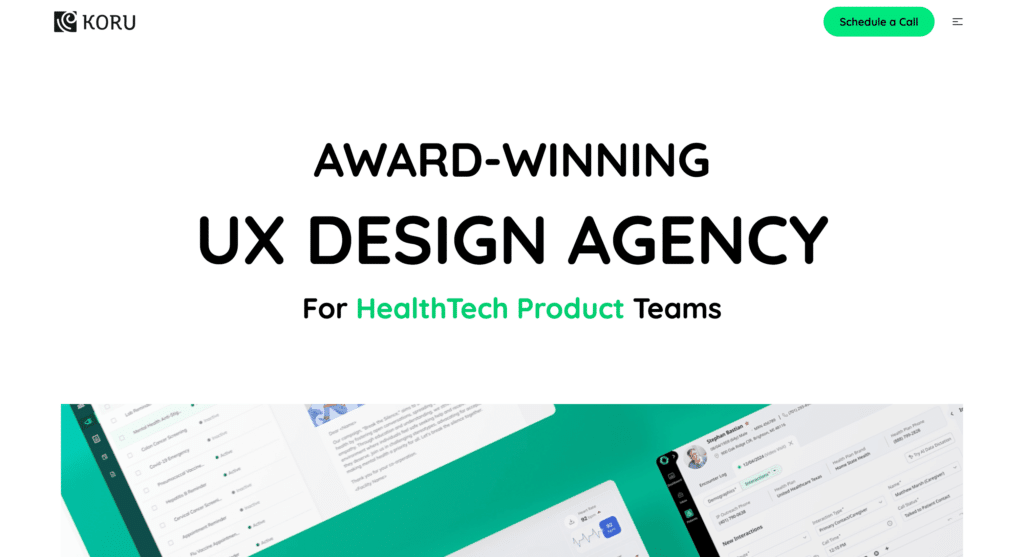
Koru UX Design specialises in healthcare technology and complex enterprise software, with clients featured on its website including eClinicalWorks, MedBridge and Acentra. Its work centres on the systems clinicians, patients and operational teams use every day: electronic health records, patient engagement, telehealth and revenue cycle management. Healthcare AI is now a prominent part of that positioning, building on its experience with demanding clinical and operational workflows.
Founded in 2011 by CEO Bansi Mehta, with Mouneet Mehta as COO, Koru is headquartered in Pune and has a US presence. It operates at the scale of a specialist studio; its Great Place to Work India profile records 41 India-based employees.
Services and engagement
Koru’s services cover UX research and strategy, product and interface design, usability audits, design systems and enterprise software modernisation. Its UX for AI practice addresses copilots, agents, ambient experiences and decision support, including the interaction design needed when a system recommends or takes action.
Its working model emphasises collaboration with product and engineering teams through sprints, regular reviews and shared design tools. Longer partnerships allow the team to build knowledge of a product’s users, business rules and technical constraints. The agency’s EHR work illustrates how this can extend across years and involve many stakeholder groups.
Approach and frameworks
Koru’s Sense–Shape–Steer framework provides a specific account of how it approaches AI products. Sense examines users’ work, the suitability of AI and the constraints around data, risk and implementation. Shape defines interactions, degrees of autonomy and what happens when the system fails or the user needs to intervene. Steer carries that thinking into implementation, evaluation and continued refinement.
The framework is supported by its UX–AI Hierarchy of Needs, which considers the progression from basic functionality to trust and higher-order experience qualities. Its guide to 14 AI interface patterns makes the subject more concrete through patterns for explaining, checking and recovering from AI behaviour. Together, these publications give readers a useful view of the agency’s thinking about human oversight and reliable interaction.
Leadership and resources
Bansi Mehta’s LinkedIn is a substantial part of Koru’s public profile. Her posts and Design Forward with Bansi newsletter discuss healthcare AI, voice interfaces, design sprints and the changing responsibilities of designers. The recurring emphasis is on understanding work and evaluating decisions as AI becomes part of the product experience.
She has also discussed Sense–Shape–Steer on UserTesting’s Insights Unlocked and ITX’s Product Momentum. These conversations offer a more extended explanation of the framework than a short article can provide.
Koru’s resource library includes guides, ebooks and webinars on enterprise UX, design systems, healthcare, accessibility and product leadership. Its UX for AI training combines video material with a workbook. A five-day AI design sprint resource and FigJam material provide another route into applying the ideas, alongside videos on its YouTube channel.
Work and recognition
The EHR case study describes a four-year programme involving more than 120 stakeholders. Its post-visit care AI copilot explores a different challenge: defining when a system should act, suggest or defer, and incorporating clinician overrides into subsequent refinement.
iF’s agency directory records six Koru awards, with recognised work spanning healthcare interfaces, design systems and other digital products. Its workplace recognition includes Great Place to Work certification in India.
Frog
frog is a global design and innovation consultancy whose work connects product design with business strategy and organisational change. Now part of Capgemini Invent, it works with major organisations such as Bupa, alongside healthcare ventures including HealthHero and MeMed. Its remit can encompass a physical product, a digital service and the business model behind both.
Founded in Germany in 1969 by Hartmut Esslinger, frog brings an industrial design heritage to an international network of multidisciplinary studios. That combination of design history, global reach and consulting capability defines its place among the larger organisations in this group.
Services and engagement
frog combines research, experience strategy, product and service design, brand development and innovation consulting. Through Capgemini, its work can connect to wider technology and transformation programmes. Its Venture Design offering extends into the creation of new businesses, including propositions, commercial models and operating structures.
The HealthHero engagement illustrates that scope: the work included the vision, pricing and operating model for a telehealth service alongside its digital experience. Its Bupa partnership describes ongoing design leadership and collaboration with delivery squads.
Approach and frameworks
frog’s process brings researchers, designers, strategists and technologists together around a problem, using research and prototyping to develop and test possibilities. Its published thinking also includes regenerative and planet-centred design, extending the questions a team asks beyond an individual interface.
One accessible expression of its approach is the Collective Action Toolkit. Developed to help communities organise and solve problems together, it provides activities for building groups, investigating needs and developing ideas. It is a public facilitation resource with a purpose of its own, rather than a description of every frog client engagement.
Leadership and resources
frog’s public voice is distributed across its practitioners. Global leader Gagandeep Gadri writes about customer experience and business change; chief design officer Chiara Diana contributes perspectives on design, technology and healthcare.
Design Mind is the main editorial platform, containing articles, interviews and reports, including FutureScape material. Design Mind frogcast adds podcast conversations with designers and leaders. The range makes it a useful place to explore how a large design organisation thinks about emerging technology, organisational change and the wider consequences of design.
Work and recognition
The MeMed project brought together device architecture, industrial design, interface design and brand over a collaboration of almost five years. The resulting MeMed Key received a 2021 Red Dot Product Design Award.
frog’s work also has recognition at the consultancy level: Forrester named Capgemini under its frog brand a Leader in its 2022 customer experience strategy consulting assessment. That recognition concerns consulting capability, complementing the product-specific design award.
Designit
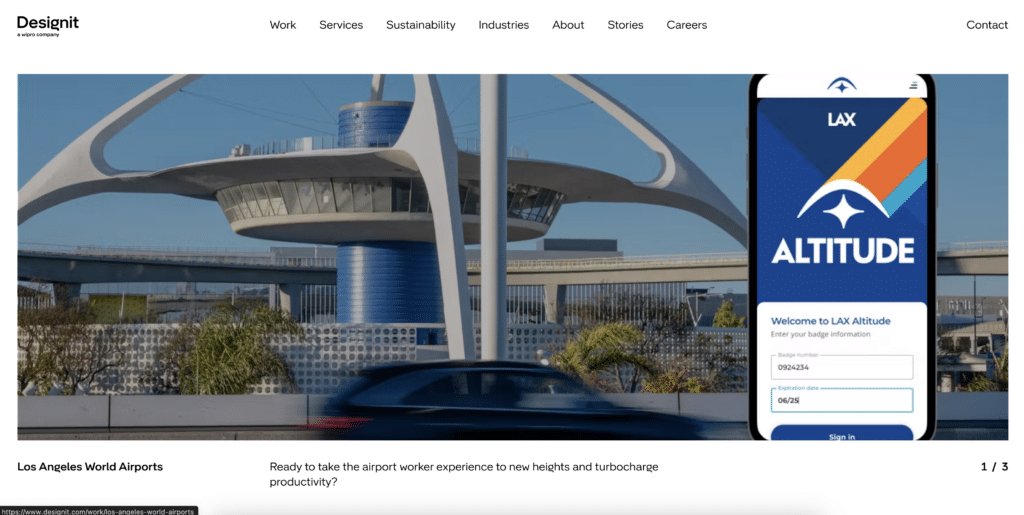
Designit is a global strategic design firm working across experience design, business innovation, brand and marketing. Its clients and projects include Microsoft Azure, Repsol and JFK Terminal 4, placing enterprise services and large, interconnected customer experiences at the centre of its portfolio. As part of Wipro, its design work can sit within wider technology and transformation programmes.
Founded in Denmark in 1991 by Anders Geert Jensen and Mikal Hallstrup, Designit joined Wipro in 2015. It operates across 11 studios spanning Europe, North America, India, Australia and Israel; Wipro describes a team of more than 500 people. Its stated philosophy is humanity-centred design.
Services and engagement
Its service suite includes strategy and innovation, experience design, branding, marketing and technology. That breadth supports work ranging from defining a service to communicating it and sustaining it operationally.
Designit’s engagement models also extend beyond discrete design projects. Its Microsoft Azure CXP work describes an ongoing communications service supporting customers during incidents. The JFK Terminal 4 project shows another part of the practice: shaping a connected airport experience across physical and digital touchpoints.
Approach and frameworks
Designit’s humanity-centred positioning asks teams to consider a wider group of people affected by a product or service. Its Do No Harm framework gives that ambition a practical form through tools and downloadable canvases for considering ethical risks, sustainability and unintended consequences.
Its Repsol generative AI work demonstrates how those questions can influence product delivery. The project developed shared principles and patterns around expectations, transparency, privacy and error recovery, integrating AI interaction guidance into an existing design system.
Leadership and resources
Keri Dawson was appointed global leader in November 2024. Her public conversations include leadership and AI accountability. European chief design officer Niklas Mortensen contributes commentary on design’s business value, creative judgment and AI, including articles for Creative Bloq.
Both have appeared on Leaders Who Care: Dawson in an AI accountability conversation, and Mortensen in a discussion of design’s relationship with the CFO. Alongside the Stories library, these appearances make Designit’s leadership thinking accessible. Do No Harm provides the more hands-on resource for readers who want to apply it.
Work and recognition
Designit’s Oslo University Hospital case study describes work on the patient referral experience, using research and workshops to address a service problem with significant human consequences. Designit reports Norwegian design excellence recognition and an IxDA People’s Choice award for the project. Its healthcare, airport and enterprise communications work demonstrates the range of systems its teams engage with.
Clay
Clay is a San Francisco-headquartered branding and digital product agency with work for some of the world’s most recognisable technology companies. Its portfolio includes Google’s Project Jacquard, Stripe’s partner ecosystem website and Slack’s interactive product demonstration. Brand identity and product experience are closely connected in its positioning, with particular emphasis on visual craft, motion and digital execution.
Co-founders Anton Zykin and Dmitry Tsozik developed Clay from their earlier SoftFacade practice; the Clay brand dates to 2016. Its website lists a team of 78 and locations including New York, Austin, Denver, Lisbon and Belgrade.
Services and engagement
Clay offers brand strategy, verbal and visual identity, UX research, product design, design systems, websites, motion, illustration, content and development. Its published engagement options include fixed-fee projects, retainers and time-and-materials arrangements.
This service mix accommodates both a defined launch and a broader programme spanning brand and product. The portfolio includes consumer-facing experiences, enterprise software, fintech and technology companies.
Approach and public profile
Clay’s work emphasises visual systems and the detail of digital execution, with research, prototyping and testing supporting the product design process. Its case studies are a useful way to see how typography, motion and interaction form a coherent experience across different formats.
Zykin and Tsozik discussed the origins of the practice in a 2018 Dribbble Overtime interview. Their account traces the business from early icon design and SoftFacade through to Clay, explaining how a focus on digital craft helped shape the studio.
Resources
Clay’s blog publishes explainers and guides on branding, websites, product design and AI, alongside its newsletter. Its Dribbble profile offers another substantial window into the studio’s visual output. The public material is particularly useful for exploring execution and visual direction, with the portfolio carrying much of the agency’s identity.
Work and recognition
The Slack project concerns an interactive product demonstration, while STC Bank covers a banking application. The Tipalti case study documents website work for the payments platform.
The Webby Awards directory records Clay Global’s Tipalti project as a 2025 nominee for Best Mobile Visual Design Function. It is a specific recognition attached to that project and category.
UX studio
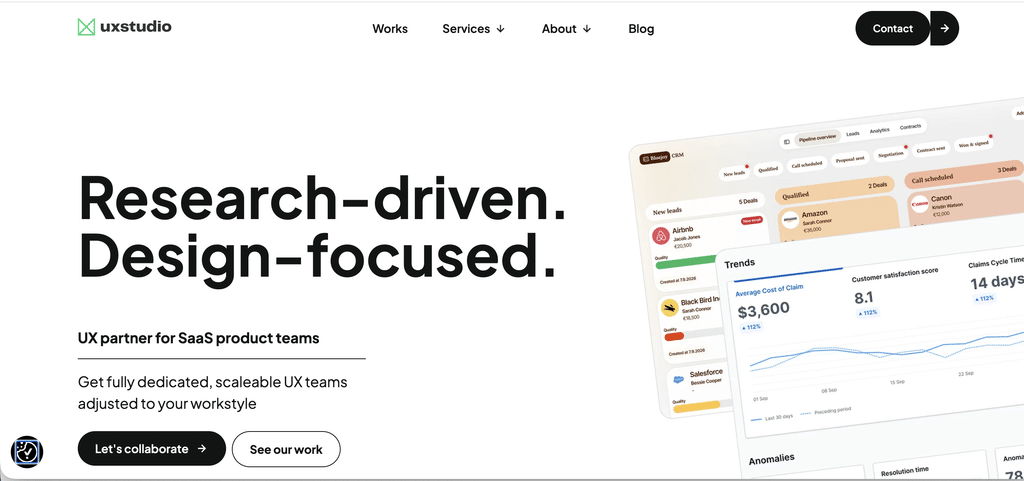
UX studio positions itself as a research-driven UX partner for SaaS product teams, supplying dedicated designers and researchers who embed in a client’s workflow. Its website features clients including Google, Netflix and Cisco, while detailed case studies explore specialist products in legal AI, insurance and healthcare. Research and ongoing product development are central to its offer.
Founded in Budapest in 2013 by David Pásztor, the agency has 74 employees listed by Built In. It also develops its own products, including UXfolio, Copyfolio, Archifolio and Ranking Raccoon, adding experience of maintaining and marketing software to its client practice.
Services and engagement
Its services include UX and UI design, user research, consultancy, design systems and development. The published delivery model describes dedicated teams joining clients’ tools and communication channels, with regular delivery and research running alongside design.
UX studio also advertises a five-day trial focused on a small set of screens. Proposals may use a fixed scope or a rate card, allowing the arrangement to reflect the work involved.
Approach and working methods
Research is prominent in the agency’s project accounts: interviews, usability tests, diary studies and successive prototypes recur across the portfolio. The case studies often explain what a team learned and how the design changed, making the working process relatively easy to follow.
The Inquisita project describes 12 testing sessions and six design iterations over eight weeks for a legal AI product. Its Oxa work, spanning two years, includes diary research around a wearable and its companion experience.
Leadership and resources
Pásztor is the author of Product Design, a book covering research, design and digital product development. He has written for Smashing Magazine and discussed the company’s own products and acquisition strategies on Userlist’s podcast.
The UX blog contains practitioner articles on research, product decisions and design. Its product management playbook covers prioritisation methods such as RICE, Kano and MoSCoW. The Design Aloud podcast archive adds interviews and discussions published between 2022 and 2024.
Work and recognition
Alongside Inquisita and Oxa, Oversee AI describes a year-long insurance software engagement informed by 20 stakeholder interviews. The range includes specialist enterprise products and consumer hardware experiences.
The Red Dot record for Oxa credits UX studio alongside other contributors. UX studio also reports Red Dot recognition for Inquisita and Oversee. Its award-winning portfolio therefore includes both collaborative physical-product work and digital applications.
Cieden
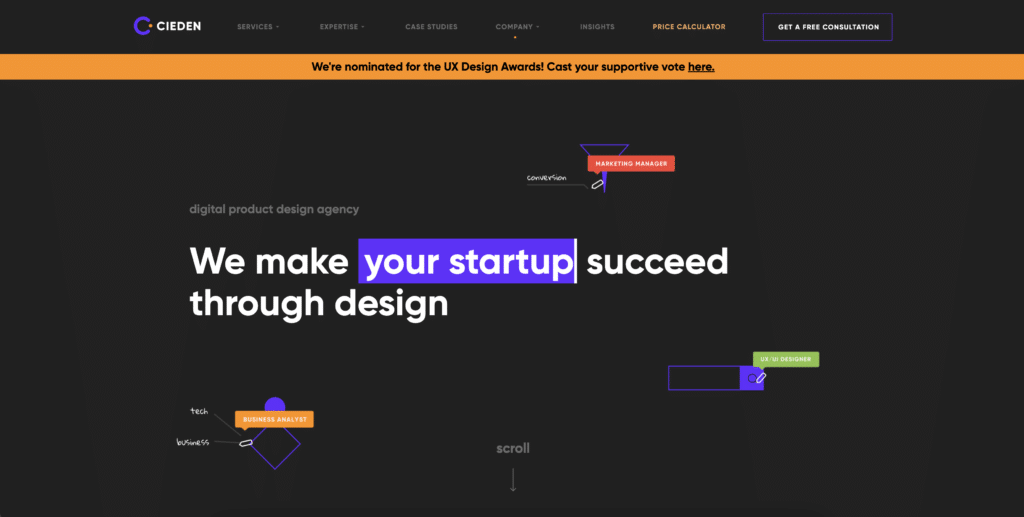
Cieden focuses on complex business software, combining product design with research, business analysis and product management. Its portfolio includes telecommunications infrastructure platform Sitenna, nutrition company LYKON and dairy logistics software OptaHaul. The connecting expertise is making specialist workflows understandable and usable, across products with very different domain rules.
The agency has roots in Lviv and a presence listed in Toronto and Delaware. Siblings Yuriy Mykhasyak, CEO, and Iryna Serednia, design director, lead a team the company describes as around 50 people.
Services and engagement
Cieden combines UX and UI design with research, business analysis, product management and design systems. Its AI services include readiness audits, strategy and proof-of-concept work, while its portfolio also includes design and development of a custom CRM.
The agency’s project accounts describe both small embedded teams and longer partnerships. Its LYKON work continued for approximately 18 months; its RevvedUp engagement describes two years of collaboration. Business analysis helps connect the interface work to domain rules and operational requirements.
Approach and working methods
Cieden’s process places emphasis on understanding the business and its users before developing flows, prototypes and interface systems. Its case studies often expose the constraints of that work. In the OptaHaul project, for example, the team describes learning about dairy logistics and using client feedback when direct access to users was limited.
That attention to domain knowledge is particularly relevant to the operational software in its portfolio, where roles, permissions and business processes shape what a useful interface can do.
Leadership and resources
Mykhasyak’s public profile connects industry practice with education, including teaching and a Kyiv School of Economics faculty profile. He writes about AI, UX and design leadership and co-hosts the Cieden podcast with Anastasia Mudryk. Guests have included Teresa Torres, Laura Klein and Jerry Colonna, broadening the conversations into product discovery, leadership and company building.
Cieden’s free Enterprise App Design Fundamentals Handbook is organised around practical interface topics such as typography, spacing and components. It is a growing reference library. Its UX skills matrix gives design leaders a separate tool for discussing capabilities and development.
Work and recognition
The portfolio includes LYKON’s health and personalised nutrition experience, Sitenna’s telecommunications infrastructure software and OptaHaul’s dairy logistics platform. The Sitenna project was a 2024 UX Design Awards nominee, recorded in the awarding body’s 2024 yearbook. It is a useful example of Cieden’s concentration on specialist B2B tools.
Eleken
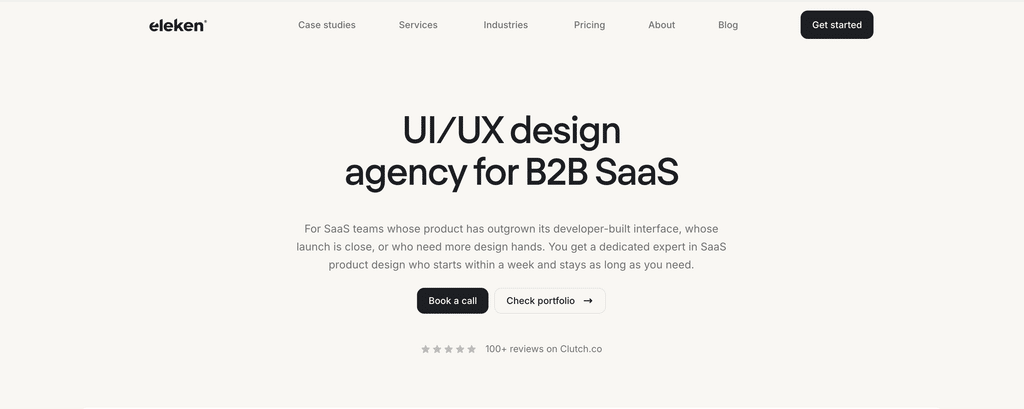
Eleken specialises in ongoing SaaS product design through a subscription model, giving software companies dedicated designers who work directly with their teams. Its portfolio includes Hubble Network, Zaplify and Aampe, spanning asset tracking, sales software and AI analytics. Its positioning centres on sustained design capacity for a growing product and its continuing backlog.
Founded in 2015 by Ilya Dmitruk, Eleken has Ukrainian roots and a distributed team of more than 100 people, according to the agency. Its work runs from early product development to redesigning and improving established applications.
Services and engagement
Eleken’s services cover MVP design, product redesign, UX audits, design systems, consultancy and team extension. Its subscription model gives clients access to dedicated designers, with part-time, full-time and multi-designer options.
Its pricing page lists a three-day trial and a two-month minimum engagement. The operating arrangement centres on direct communication between the client and designer, supported by senior design guidance. For product teams with a continuing backlog, that makes design capacity part of regular delivery.
Approach and team development
Eleken describes its operating principles as Talent, Transparency and Tempo. These concern the people doing the work, visibility into delivery and the pace of progress. Senior reviews and peer feedback support individual designers.
The agency also describes a three-month internal designer bootcamp. This is part of its team development process, distinct from the resources it makes available to the public. It gives readers some insight into how a larger subscription practice develops consistency across its designers.
Public profile and resources
Eleken’s public presence is carried largely by designer-authored articles, case studies and visual work. Its blog contains an extensive collection of SaaS design explainers, including onboarding, dashboards, research, product metrics and interface patterns.
Its ebook library offers longer resources on UX research, working with designers and design-related growth metrics, among other topics. These publications make the agency’s SaaS specialism useful to readers who are developing a product or organising a design function.
Work and project examples
Hubble Network explores geospatial interfaces, user roles and device-related workflows, including mobile QR interactions and imports. Zaplify illustrates ongoing work on onboarding and iterative experimentation. Aampe adds an AI analytics product to the portfolio.
These accounts show the range within Eleken’s SaaS focus: the common thread is sustained work on a software product, with the details shaped by its users and domain.
Onething Design
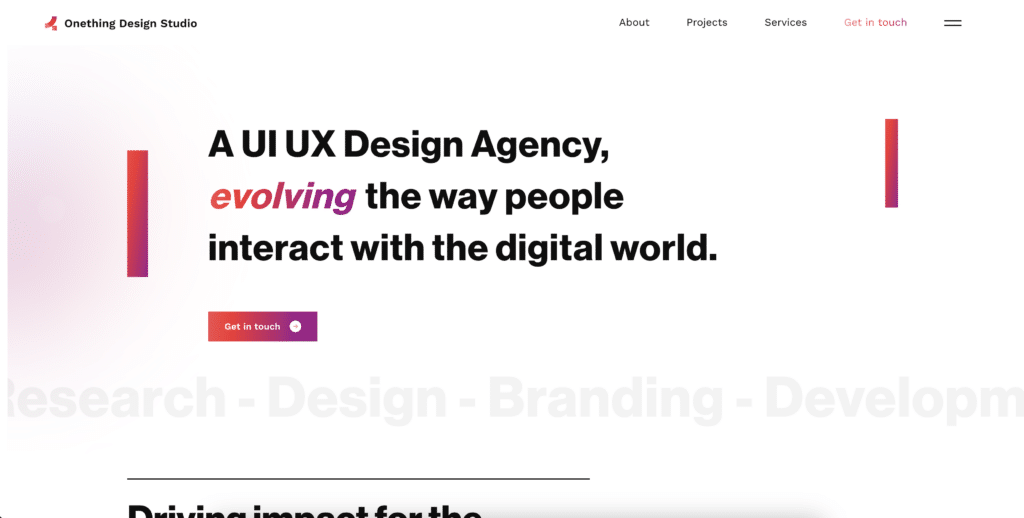
Onething Design works with major consumer and financial services brands, with projects including the Royal Enfield app, HDFC InvestRight and Qubo’s connected-device experiences. Its portfolio has a strong concentration in mobility and finance, where a digital product sits within a wider relationship involving purchases, service, support and ongoing use.
Headquartered in Gurugram, the agency was co-founded by Manik Arora and Divanshu Thakral. They began with Ketchup in 2014 before establishing Onething in 2015. The agency reports more than 70 people, with capabilities spanning experience design, brand, development and motion.
Services and engagement
Onething offers UX and UI design, research, customer experience strategy, branding, websites, development, motion and CGI. Its newer Agentic Experience Design, or AXD, offering focuses on experiences involving AI agents.
The agency describes project, retainer and dedicated-team engagements. Its published guidance puts typical projects at eight to twelve weeks, with larger enterprise work extending further. These are indicative delivery ranges; the portfolio includes programmes involving multiple teams and systems.
Approach and working methods
Onething presents its approach as human-led and AI-accelerated. Its delivery process covers discovery, flows, wireframes, visual design, prototypes, design systems and development handoff. Its published culture values emphasise respect, experimentation, supporting colleagues and speaking honestly, adding a view of the working environment behind the projects.
The Royal Enfield app project shows how that works across a broad product: the experience connects configuration, service, community and vehicle-related features. The case study describes design tokens and collaboration across teams, providing a concrete account of how the agency organises consistency in a substantial digital ecosystem.
Leadership and resources
Manik Arora publishes on LinkedIn about AI, changes in the design process, search and team practices. His public writing also includes contributions to UXmatters. The agency’s blog, newsletter and community activity extend that public presence beyond the founders.
Its white paper library includes On the Horizon, covering fintech and banking design trends for 2026, and Automotive Experience Evolution, addressing the journey from curiosity to loyalty. These longer publications complement its case studies and reflect two recurring areas of its client work.
Work and recognition
Alongside Royal Enfield, the portfolio includes HDFC InvestRight, Qubo and Traqcheck, demonstrating financial, connected-device and AI product work.
Indigo’s 2025 award announcement records Gold for UX, Interface and Navigation and Silver for Interactive Design for Onething’s Royal Enfield work.
UITOP
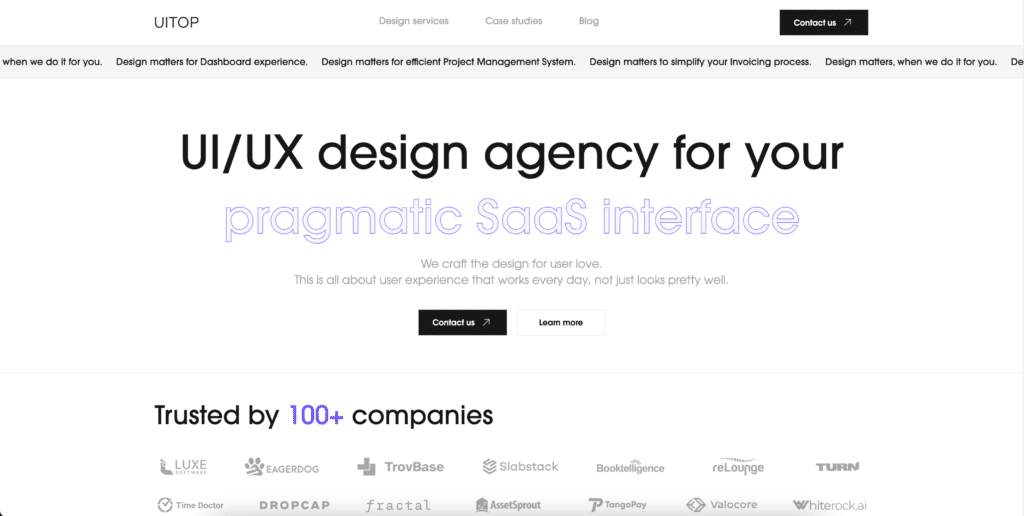
UITOP is a product design and engineering agency focused on B2B software and industry-specific operations. Its projects include Activate OS, healthcare accounting platform Pacioli and construction ERP software. The practice connects UX design with implementation, particularly where a product must reflect detailed workflows across field teams, office staff and business systems.
Founded in Ukraine by Ivan Klyzhenko in 2021, UITOP recorded 39 specialists in its 2025 company timeline. Its focus spans construction, logistics, manufacturing and accounting, including ERP and CRM applications.
Services and engagement
UITOP combines UX and UI design with software engineering. It offers initial design work, ongoing product growth and engineering squads, giving clients several ways to start and expand a relationship.
Its published process includes a three-day trial and frequent communication through Slack and Loom. The service mix is geared toward teams that need the product’s interface and implementation to develop together.
Approach and working methods
UITOP describes a UX-first approach to engineering. Its account of AI in its process discusses using AI tools while retaining human control over architecture and quality.
Its projects frequently involve detailed operational workflows: connecting field and office teams, managing permissions or translating financial processes into software. The work is therefore as much about understanding an organisation’s day-to-day activity as designing individual screens.
Leadership and resources
Klyzhenko’s LinkedIn and authored articles cover product design, AI and the practical challenges of business software. Construction and the connection between fieldwork and office systems are recurring subjects.
UITOP’s blog combines UX explainers with engineering and industry topics. Its Substack and YouTube channel provide additional written and video material. The public resources are concentrated in articles, commentary and demonstrations.
Work and project examples
Activate OS describes a relationship that developed from a pilot into a seven-person R&D team over three years. Pacioli covers healthcare accounting software and an AI-assisted financial workflow. Its construction ERP work adds another example of software built around industry-specific operations.
Together, these projects give a clear view of UITOP’s place in the agency landscape: a specialist team connecting product design with the engineering of business applications.
Taqwah
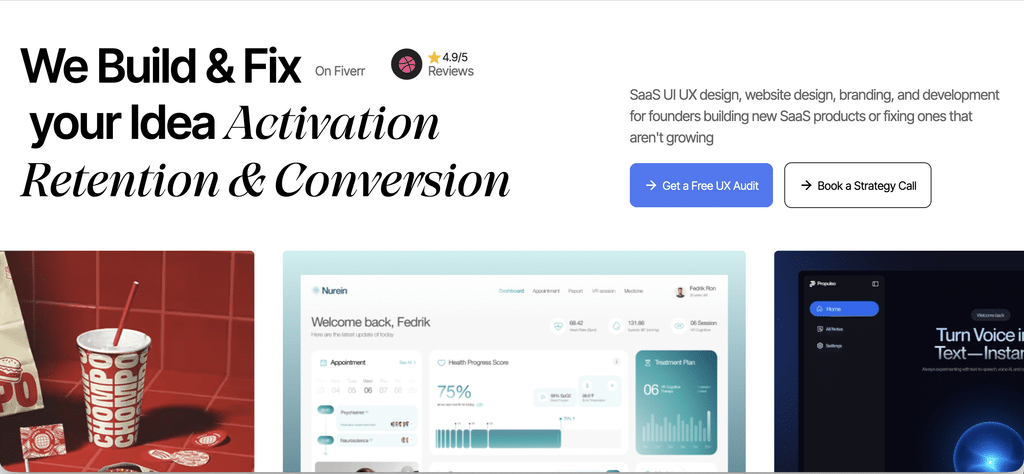
Taqwah is a small design and development practice focused on SaaS startups and smaller businesses, offering product interfaces, onboarding, landing pages and branding through a monthly model. Its portfolio includes Propulso’s AI voice-to-text product, DeepSift’s AI image detection experience and Chompo’s food brand and ordering work. Its positioning puts compact delivery cycles and practical product improvements at the centre of the offer.
Founder Imrul Kayes leads a Dhaka-based team with origins in freelance and marketplace work. Its website introduces nine named team members, while its Fiverr agency profile lists 15 employees. It also has a UK company incorporated in April 2025.
Services and engagement
Taqwah offers product UX and UI, audits, onboarding design, landing pages, branding and development. Its service material also addresses products created with AI development tools such as Lovable, v0 and Bolt, including the work needed to improve their interfaces.
The agency promotes a monthly arrangement, two-week sprints, direct designer access and a three-day trial, alongside a 48-hour audit offer. This gives its service a compact, accessible form for teams with a defined product or website problem.
Approach and working methods
Its stated sequence is Audit, Design, Ship, Measure. The process connects an initial diagnosis with design and implementation, followed by measurement using tools such as Mixpanel, Microsoft Clarity and PostHog.
The supporting service descriptions include component systems and design tokens, with implementation across technologies such as React, Vue and Next.js. This makes delivery and subsequent product behaviour part of the offer alongside the design itself.
Leadership and resources
Kayes’s LinkedIn includes SaaS interface commentary and teardowns, particularly around onboarding, activation, empty states and unnecessary complexity. His Dribbble profile provides a visual view of the work.
Taqwah’s resources are especially tangible: Figma and Webflow templates, including dashboards and landing pages, and a SaaS Hero Audit tool. These give readers examples and starting points they can inspect directly. Its blog adds SaaS design and agency-related articles.
Work and project examples
The portfolio includes Propulso’s AI voice-to-text product, DeepSift’s AI image detection experience and Chompo’s food brand and ordering work. These examples show the studio moving between SaaS interfaces and the brand and website work that supports a smaller business.
Taqwah’s public identity is rooted in that practical output: founder commentary, templates, product interfaces and marketplace client relationships.
Essential Guide to Selecting the Top UI/UX Design Agency
Partnering with an expert external UX design agency saves costs up to 63% for product companies across sectors and sizes. However, these savings materialize only when you partner with an agency that aligns with your needs. To guide you in finding that perfect match, we’ve compiled a short quiz for selecting the right UX design agency:
A Quiz to Selecting the Right UX Design Agency
Answer the following questions based on your preliminary research –
1. Do they possess the right domain expertise and experience to handle your project?
Yes/No
2. Have they shared case studies or testimonials from clients belonging to similar sectors?
Yes/No
3. Have they won any awards and recognitions for design excellence?
Yes/No
4. Do they offer strategic business value through their design expertise?
Yes/No
Answer the following questions based on your interaction with the design agency’s representatives –
5. Do they command a grasp of the complexities and user behaviors of your industry or requirements?
Yes/No
6. Have they solved a design problem close to or similar to yours?
Yes/No
7. Are their designs development-friendly?
Yes/No
8. Do they showcase expertise in the latest design tools and technologies?
Yes/No
9. Does their pricing structure align with your budget expectations?
Yes/No
10. Are they fit for a worthwhile and long-term collaboration?
Yes/No
Scoring
Award 1 point for each question answered ‘Yes’; the highest scorer will be a safe bet for your project.